and the insults of those who insult you fall on me.”
Today, I was reading Psalm 69, and this duo of verses caught my attention. As we approach Holy Week, we remember Jesus’ cleansing of the temple. During John’s account of this event, the gospel writer quotes Psalm 69:9, saying, “His disciples remembered that it is written: ‘Zeal for your house will consume me.’” Thus, Psalm 69 is placed within the Holy Week narrative as a Psalm that Jesus lived out in the week leading up to his death and resurrection.
This connection to verse 9 is made plain by the gospel writer, but recent discussions in my small group drew my attention closer to verse 8. John 7:5 says, “For even his own brothers did not believe in him.” Well into Jesus’ ministry, when he had done signs garnering much attention, he was still so lowly, even amongst his own family, that he was not believed. (1) While we often dwell on Jesus being betrayed by Judas, Peter, and the other disciples during Holy Week, he is first rejected by his own family.
Beyond even the rejection Jesus faced from his disciples and family, Jesus is also rejected by those who claim to follow the Father. The psalmist of Psalm 69 writes in verse 4, “Those who hate me without reason outnumber the hairs on my head; many are my enemies without cause, those who seek to destroy me. I am forced to restore what I did not steal.” We may read “those who hate me” as the Pharisees, who claim to follow God yet “do not know the Father.” (2) Though Jesus is isolated from all those who should love him and who claim to know God, he still restores them, dying in the way of sinners though he knew no sin.
This picture of an isolated, lowly Jesus is the face we gaze at during Holy Week. This is the man of sorrows: He who lived a life rejected and despised; lowly and disbelieved. Yet, even in this condition, he brought restoration to all that was around him. In this Lenten season, the Christian is mercifully drawn nearer to him in his sufferings. Knowing our weakness, we repeat the words of Paul with rejoicing, proclaiming: “[your] power is made perfect in weakness.” (3) Though I am weak and poor of spirit, my God became even lower than I, so that all of humanity may be restored to him. For what is not assumed is not healed, yet Jesus assumed all our sufferings in harmony with the voice of the psalmist who writes, “I sink in the miry depths.” (4) Knowing this, I rejoice all the more in my savior, who has known all my suffering and more; in faithfulness to the Father, he restores it all to glory.
I hope you enjoyed some of my reflections on Psalm 69 heading into Holy Week. I was very affected by reading the Psalm this morning, and wanted to share. My song recommendation for this post is “Button on Brown” by Alan Gogoll. It’s a peaceful and jumpy tune that I’ve been loving recently. Peace to you, and thanks for reading!
(1)John 7:11-12 says, “Now at the festival the Jewish leaders were watching for Jesus and asking, ‘Where is he?’ Among the crowds there was widespread whispering about him.”
Today, I was listening to a podcast about Knowing and Being Known by Erin Moniz (one day I’ll read the book, I’m sure it will get a post, too). I kept hearing themes about generations and how the Church does community. My mind immediately thought about how we ask questions. I am fortunate to be friends with many great question askers— people who use their words to invite people into closer community. And, I am fortunate to be living at home and get to observe my grandmother ask questions. I’m amazed by her consistency in remembering the right questions to ask to make sure she’s checking in on people. Yet I was hearing in this podcast how many people do not experience these good questions, especially in church. “Community is inconvenient,” my friend Bethany has said, and we are so eager not to inconvenience others. I think I have cited my sources well enough here. I will not try to further force my thoughts into prose, they need room to breathe in poetry. I hope this poem finds you well 🙂
“To Have and to Hold”
I belong to a grandmother,
A lifelong church-woman;
A Georgian for all her years;
Someone who knows how to ask questions.
She asks many.
“How’s your mom doing?”
“How’s he doing in school?”
“How’s she liking it in Florida?”
“What are they doing for work now?”
Belonging to a church who knows what it means to have,
An older generation who inquires about what they know is important.
I belong to a younger generation,
One skeptical of the church;
Of people in general.
Often isolated.
Afraid to answer too truthfully.
I wonder
Do we let people in enough?
Are we too afraid to share?
Perhaps we are not letting people have us
Because we are afraid of what will be found
By others and ourselves,
And how we’ll react.
I belong to a younger generation,
One who loves to hold.
We insist on a seat at the table for all.
We insist on everyone being welcomed
Because who they are is good.
I wonder
Do we ask enough about people?
Do we dismiss them as good
Without taking the time to ask
And learn about their beauty?
Insufficient parts
One generation has
They know others
They want to hear all about them
The other holds
They welcome others
So that all are accounted for.
They need one another.
To have: necessary;
It lays the groundwork for being known
Yet it’s insufficient
Nor is it to hold;
Everyone wants to be accepted
But none can be accepted without first being known.
The delicate balancing act of questions,
Knocking on the door of others’ lives
Too soft— too vague
One will never be known.
Too loud— too direct
One is intruded upon.
Can we forgive?
The cost of community.
Being asked too much of and being hurt.
Reconciling and restoring relationship.
I belong to a grandmother,
An example.
One who asks every time
Because she wants to know.
“How’s your mom doing?”
“How’s he doing in school?”
“How’s she liking it in Florida?”
“What are they doing for work now?”
I pray my generation learns to have and to hold.
The example I’ve been given.
That we may be the bride of Christ.
Song of the day: Welcome by The Arcadian Wild (in fact, much of that album is on theme for this post).
This week, my students have been writing their first essay of the year. I thought it would be compelling motivation to write my own essay alongside them. Further, they recently had a city-wide competition where they could write a tribute about the life of Jimmy Carter. And, even beyond that, I just finished reading a book by Jimmy Carter. All rolled into one, I almost had to write this essay. It has been edited under the brain fog of a mild cold and was written on a Friday night after a week of teaching. That is to say… be kind and one day I may improve upon my thoughts on these themes. The teacher in me, however, says it’s important to write as practice and that progress is greater than perfection. So, now, here’s some thoughts about Jimmy Carter and what makes a modern hero.
“Jimmy Carter and Modern Heroism”
We celebrated my Pawpaw’s life at my aunt’s home in small-town Georgia. Around a hundred people gathered in her home to eat barbecue and reflect on our loved one’s life. I prayed, and both my aunt and uncle gave eulogies. Soon after, we went through Pawpaw’s belongings. I had been away for college, so I only had pone box to consider. I kept a couple of shirts, a silver dollar from his birth year, and Sources of Strength by Jimmy Carter.
I have a friend who believes that America has a major problem devaluing its heroes. The founding fathers, he says, are hated when people judge them by modern standards. More recent figures are discredited, too. Abraham Lincoln wasn’t enough of an abolitionist and Dr. King had a troubled personal life. These points are used to discredit these figures and other people of historical importance. Their flaws keep them from being held as heroes in many peoples’ eyes. My friend believes the logical end of this is a society that no longer knows how to choose right because they have learned only how to find the wrong that people do.
If my friend is right and America has discredited its heroes, then someone should tell my family, because we haven’t gotten the memo. In Pawpaw’s assisted living, on a sparse bookshelf, he featured a devotional book by one of his heroes. The whole lot of my family are from Georgia, and we’re proud as can be that our state’s only president to date is the smiling peanut farmer. The man acclaimed for his moral principles and Christian faith is our hero. Every conversation about Carter starts the same; “he may not have been a great president, but he was a great man.” In a way, his questionable effectiveness as a political leader makes him a perfect paragon hero.
First, let’s do what we must as a modern audience. Let’s discredit the hero. Political history is not my expertise, but, as I understand it, Carter was not an effective president. He was too weak for the Cold War, too hard to work with to get bills passed, and unwilling to choose political savvy over ideals. His four years in office were quickly whisked away by a Reagan campaign that promised America a stronger leader.
If these few points illuminate his failures, how can he be a great modern hero? I raise another question in response. If every figure will be discredited in some way, is it better to be discredited for their effectiveness or for their ideals? People look to heroes to inspire them. Heroes remind us what we believe in, so if they have to be flawed, its a greater problem for them to be flawed in their ideals than in their effectiveness. In my family’s stance, his presidential term is of minimal consequence because he spent much more of his life loving his family, teaching Sunday School, and building houses with Habitat for Humanity. He is a hero not for his political effect, but because he served as the most powerful man in the world and came home at the end of the day with his soul.
Let us now consider that soul. What, in his words, does he stand for that is so heroic? Sources of Strength is a collection of 52 devotional chapters based on his years of Sunday School notes. I will focus on a few chapters that exemplify his stance. First, he is humble. His second chapter (after the first outlines what a Christian is) is on Jesus, the humble servant. Carter’s picture of Christ is like that of Isaiah 53. He is the man of sorrows, from “a lowly family” whose disciples were, at his death, “not fully convinced” (p. 10). But, of course, Carter proclaims this man to be Lord. He emphasizes himself and other Christians as servants of God. If Christ was humble, then his servants must be all the more humble. As a hero, then, Carter exemplifies an ideal of humility.
In humility, Carter is deeply concerned with how people live. He writes, “Have I lived in a way that is truly compatible with the teachings of the humble, human, yet all-loving and all-knowing God I have pledged to follow?” (p. 14). Much of his book demonstrates his serious contemplation of this question. One way he believes the Christian must treat others is with forgiveness. He calls this the “special message of Christ,” —the thing that distinguishes Christ’s moral message from the other most influential teachers (p. 20). He believes this must extend beyond all reasonable quantity of offenses forgiven and beyond all reasonable people groups to forgive. Further, he calls upon self-sacrifice as a ruling principle of Christian living. He uses the famous example and writings of Dietrich Bonhoeffer (whom I hope I am soon to read) to emphasize the importance of Christian sacrifice. In an America where free speech is protected, Carter says Christian sacrifice is of one’s own well-being for the sake of others (p. 45). Each principle laid out here follows that principal. Carter believes in seeking others’ well-being over his own.
Before moving on from the book, let’s take one more case of Carter’s heroic ideals. In the chaper entitled “What can one Person Do?” Carter tells the story of two noteworthy events within the congregation of Marinantha Baptist Church during 1976. For one, a man named Jimmy was nominated president of the United States. Second, a family was sent to the country of Togo as missionaries. For this chapter, the presidential author focuses on that second event. He tells of the Ethridge family who, through bringing sustainable food, water, and Health Services to the people of eastern Togo, brought many people to believe in Christ (p. 136-138). In framing this example in such a way, Carter continues to put others before himself. He upholds the dignity and human rights of the Togolese people by focusing on their physical needs being met, and he upholds the value of two people’s work through the impact of the Ethridge family. As a hero, Carter uplifts others and encourages them towards following the example fo Christ with him.
Without belaboring the point, I believe Carter’s written work gives organization and words towards the beliefs that guided his life of service. He is a hero because he was fiercely consistent in his humility, self-sacrifice, and belief in the impact of humans working for good. Perhaps, it is the most beautiful part of his story that he was greater as a layperson than as a world leader. In reading, I was amazed at how familiar every lesson felt. To the experienced Christian reader, Carter presents very little new information, but he does so with clarity born of lived faith. This is what makes him a great hero for my southern Christian family. His life was exemplary for its replicability. Pawpaw could not be president, very few people can, but he could live humbly in love after the example of one of his heroes. And I, in turn, can live holding my Pawpaw as a hero.
I am not sure if my friend is correct that we have discredited our heroes. I believe in heroes that make mistakes because I believe in a God that redeems our failings. Perhaps we should awake to our heroes’ failings while recognizing their exemplary traits. It is ok to learn from a man who was a poor president if you’re not trying to be president. If you look towards him— or better, the Lord he follows— you won’t necessarily learn how to be perfect, but you may just learn how to be a greater human.
I have not written in the past month or so because I have been working my first month as a 5th-grade teacher. It is good work, joyful even, but tiring and seemingly all-consuming. Rarely have I had time to think of much outside of how I’m going to make sure these 10 year olds are safe and learning. But this Sunday, I breathe. In fact, I am finding that as each Sunday comes and my God welcomes me to His time in Sabbath, He has something for me. When the week falls away and the new one arises, the constancy of this holy day returns me to center.
Though I am still learning how to do the work before me, I have perspective to feel that learning to be a little less desperate. I am repeatedly invited to the experience of being both a shepherd and a sheep. In the language of Nouwen’s Return of the Prodigal Son, I am beckoned to be both a son and a father. I sit at the foot of the cross at the close of Holy Eucharist and am asked to feed the Lord’s sheep as He has fed me. I am keenly aware of my weakness and almost equally aware of the need to be strong for a gaggle of blessed children. So, as I take a breath this Sabbath day, I rejoice that I have time and energy to write.
My aunt and uncle gave me a copy of Every Moment Holy for my birthday, and I was inspired to engage with an increasingly familiar experience through writing in the style of the book. Below is “A Liturgy for Receiving Bad News as a Teacher,” written as a way to call on God’s help when I come up against challenges in a student’s life that are too large for them or me to bear. Sometimes, kids have challenges in their lives that need for me to bring out the big guns. The big guns, of course, being our eternal creator.
“A Liturgy for Receiving Bad News as a Teacher”
Most merciful God—
You, who saw Hagar in the wilderness
Who sees every mother’s child now—
Have mercy upon your children.
To those who cannot control the homes that they live in;
Who seek to impress the wrong people
Who fall prey to bad influences
Who are taught to fight so that they may not be taken advantage of
Bring justice, oh Father.
To those who do not have the skills to choose
Reasoned responses to hardship
Peaceful reactions to unkindness
Or perseverance when challenges arise
Show grace, oh Father.
To those who have missed so much school
And have not enough hours in the day to catch up
Discouraged and unsure
If they are smart enough for this
Bring comfort, oh Father.
Those who do not understand the words around them
Spoken in a language foreign to them
Acting loudly
Because actions speak when words can’t
Hear them, oh Father.
And for me
The teacher
Your child
Give me the strength to feed your sheep
Patience to listen before acting
Grace to help and never judge
And hope to believe that you will make right all things
Hey, I’m finally writing about a book! This summer, I read Henry Nouwen’s The Return of the Prodigal Son. Inspired by a mystical encounter with Rembrandt’s painting of the same name, Nouwen writes about Jesus’ parable, focusing on both featured brothers and their father. He describes not only the happenings of the parable, but places himself in each character’s shoes and invites the reader to do so as well. I found his insights deeply moving and rejoice that I get to read books with such wisdom in spiritual formation. That said, I have yet to discover what spiritual truth learned from it will be most impactful to me. Acknowledging such, I write here as a student who needs to ruminate on the vision of Christian life that Nouwen presents. As a starting point, I will reflect on one theme which I find ever present throughout the book: the depth of Christian freedom.
Freedom, as Nouwen illuminates, flows from the character of the father. His chief characteristic, shared with God in all of Nouwen’s work I have read, is his “heart of limitless mercy” (75). This is the constant in both son’s lives. It is the singular unfailing thing that prevails for all their days. The sons, in their lostness, believe that the father’s love must be split amongst them. They have seen their father’s mercy, no doubt, but are ruled by a belief that it may run out if one uses it too much. One of them will have more of the father and the other less. Yet, in Nouwen’s words, “The Father’s heart… is not divided into more or less,” and “there is nothing that the father keeps for himself” (103, 130). This father offers his mercy as an inexhaustible resource to both sons. Through his long life, he has come to offer a degree of mercy that seeks nothing greater than for his sons to be home. Having seen so much of what the world has to offer, he rejoices simply in the return of his son. God, seeing all, rejoices, “not because the problems for the world have been solved… No, God rejoices because one of his children who was lost has been found” (114). I have heard it said that not only is the son prodigal (read: wastefully extravagant), but so is the father. The father gives far beyond what his sons deserve and far greater than what he seeks. He loves them with an extravagance that they cannot comprehend. This is the character of the prodigal father and of the God whom he teaches about.
It is because of the endlessly giving character of the father that his sons have total freedom. He tells the older son “everything I have is yours” and demonstrates the same to the younger son (2). Though the sons are born into freedom because of their belovedness by the father, each of them chooses to stray. The younger son acknowledges his loss of freedom, planning to return to the father and beg to be treated as a “hired man,” yet his father, in his mercy, will hear none of it. Instead, he receives the younger son in “the Divine love and mercy in its power to transform death into life” (37). The son has left any rightful claim to his father’s house, and is dead in such, yet his father welcomes him back into life abundant. The younger son, in asking for his inheritance, tried to force his way to freedom. Once he had it, he realized that his blessedness lay only with the father.
The older son, on the other hand, has always lived with the father. Even so, he has given up his blessed freedom and is ruled by resentment. Nouwen describes this experience of pious older siblings as a “certain envy toward their younger brothers and sisters who seem less concerned about pleasing [others] and much freer in ‘doing their own thing’” (69). In his envy of his brother, the older son has forgotten that everything the father has is his. In fact, he has rejected what the father desires to give when he is angered at the father’s joyful celebration. Nouwen illuminates this portion of the parable by writing, “joy and resentment cannot coexist. The music and dancing, instead of inviting joy, became a cause for even greater withdrawal” (73). The parable does not, however, end on the older brother closing the door on joy. We do not know how he responds to the father’s invitation. What we do know is that, in love, the father has given his sons a choice. The older son may choose resentment in this parable, but the character of the father is to offer him another chance for joy tomorrow.
The sons’ experiences of the father’s mercy and joy are the source of their freedom. Their father offers all he has to them and endlessly desires to welcome them home. The same is true of the Christian as a child of God. Nouwen discusses the Christian’s opportunity to return with a case study on two of Jesus’s disciples, writing, “Judas betrayed Jesus. Peter denied him. Both were lost children. Judas, no longer able to hold on to the truth that he remained God’s child, hung himself… Peter, in the midst of his despair, claimed it and returned with many tears” (50). Here is described the first of two freedoms God provides His children with: the freedom to claim one’s status as a beloved child. Judas was born as a son of God. So was Peter. Each of the brothers of parable were one. If one is unsure these figures are sons, they need only look at their faces. They are in the very image of the Father they reject. Yet the Father, in his prodigality, will give them their inheritance early if they ask. They are free to reject their sonship if they desire. In fact, all of them do at one point. The father knows this, as Arthur Freeman is quoted “the Father loves each son and gives each the freedom to be what he can, but he cannot give them freedom they will not take nor adequately understand. The father seems to realize… their need for his love and a ‘home.’ How their stories will be completed is up to them” (78). Somehow, the Father sees fit to give His children the freedom to reject Him. Somehow, He offers the gift of mercy each time they seek to return. I cannot comprehend this love. It makes no reasonable sense to me. Yet the Father is generous to give each human the freedom to take up their status as His heirs.
The second freedom flows from one claiming heirship. This freedom is described by the father throwing a feast for the younger son and telling the older that all that is the father’s belongs to the son. When one owns their status as God’s child, they are once again in connection with a freedom Nouwen calls their “basic blessedness” (50). In choosing to receive the father’s invitation back into his home, one is ushered back into the household they were always intended for. Life does not cease in its challenges, but the child is able to rejoice with the father once more. This freedom is not mere freedom of choice, but freedom towards life abundant. Nouwen, on his spiritual journey, describes his temptation to leave the Father and go on a quest to win love. He has come to realize, however, that “as long as [he] remains in touch with the voice that called [him] the Beloved, these questions and councils are quite harmless” (41). Being at home with the Father is freedom because it allows a new perspective. From this perspective, one’s basic blessedness is put into focus and sorrows are met with the great mercy of the Father.
One conclusion follows, in Nouwen’s story, from the freedom found with the Father. It is equal parts a blessing and a challenge.When one is home with the Father, they grow. A nurturing home gives a child great conditions for growth. Further, this home holds a parent to which the child can aspire towards. It is precisely because of the freedom that Christians, as children of God, find with the Father that they have a responsibility to grow in His likeness. One step of this growth is to ask Nouwen’s question “how am I to let myself be loved by God?” (106). To become like the Father, one must let themselves know His love. A Christian who holds God at arm’s length may be transformed to a point, but they can never know the fullness of the Father’s love. They are like the older son who, resentful of the father’s celebration, distances himself from both his brother and father (81). The greatest commandment is to love God and neighbor, and one can do neither without the piercing comfort of the Father calling one beloved. The Return of the Prodigal Son is a reminder that home is closer than all us who lose our way could ever imagine. When home, we are reminded of our belovedness and invited to do more— to “confront, admonish, and encourage without fear of rejection or need for affirmation” (39). Here, we are a beloved child, and here we may grow to serve something greater.
Thanks for reading my thoughts on Nouwen’s Return of the Prodigal Son. I found the book so impactful and full of resonant thoughts that it was hard to narrow them into one essay. I heavily recommend reading it if you were intrigued by any of the concepts I’ve been sitting with. Below are two recent poems. As for music, I’ve been sitting with, I’ve been listening to Jess Ray’s MATIN albums in the mornings, with the standout track being “In the Meantime.”
Recently, I’ve been writing poetry as a way to condense reflections of themes in my life or recent experiences. I thought of the idea for this first one, “What Do you See?” when I was thinking about the small number of images I can clearly see from my childhood. I very rarely see images in my mind, so to be able to see something, I must have spent a lot of time in a specific place or thinking about a specific memory.
“What Do you See?”
What does childhood look like?
What does it sound like?
Taste
Smell
Feel;
–
I see a track with too many sticks on it.
The storm has passed;
I still can’t ride the neighbor’s scooter.
Like the shiny spot on Pawpaw’s head
A hole dug deep into the Georgia clay
Just to see where it would go.
–
I hear a gentle southern drawl.
Mammy answering trivia questions from the other room.
A kitchen with a song to dance to.
Clicking of a mouse;
Solitaire on a desktop.
–
I taste hoecakes
Soft and buttery, fresh from the cast iron.
Graham crackers and milk
Soaked for a tad too long.
The raisins out of the bran;
Flakes left for the adults.
–
I smell honeysuckle
Too apprehensive to taste;
And mildew
A couch too comfy to waste.
Mom burns incense to drown out
Puffs of a cigar,
–
Headache brought on by conflicting smells
Warmth of a hot meal
Sore stomach from laughing
Heavy eyes lying awake
Pieces held together in this body.
————————————————–
I’m thankful to have traveled much more than ever before in the past few years. Each place I’ve visited, I’ve loved speaking to different folks and learning how they extend hospitality to visitors. I wanted to capture the little moments I experienced in each place while celebrating the joy of returning home.
“Beating Around the Bush”
Los Angeles, California
2 churros please
You know, I played here once
Koufax was incredible
Best I’ve ever seen
I hope things work out with her.
–
Osaka, Japan
Teachers change classes here
Not students
Here’s your map
Sensei will be here if you have any questions
Japan’s best friend.
–
Baltimore, Maryland
If I buy tickets, can we sit anywhere?
Here’s your pitcher
You’ll need it
It’s a shame you don’t drink
Thanks for having us.
–
Atlanta, Georgia
Come on in
Can I get you something to drink?
How’s your grandma doing?
That room sleeps hot
There’s a fan if you need it.
–
We beat around the bush.
There’s a script
Tried and true
For people to be known.
————————————————–
Finally, my friend Hannah and I wanted to write poetry one day, so we gave each other a title and 8 minutes to write a poem. This one is a tribute to my goofy orange cat who dips his paw into a water fountain in order to drink.
“Cat Water Fountains”
Flick flick flick
He swats
And licks
And repeats;
An orange ball of fur
Quenching his thirst
–
Why does he do this?
Does it serve survival?
Is it necessary?
Perhaps the wrong questions.
He is safe;
Free to choose
His own methods of drinking water.
–
A fountain is provided;
No fear for survival.
He gets to be silly.
Both questioned and loved for his behavior
–
What wonderous things one does when they are comfortable
Am I not the same?
————————————————–
If you’ve gotten one music recommendation from me in the past year, it’s probably been The Orchardist. Today’s recommendation is their song “All of Me” (or “Sentimental Man,” if you have Apple Music access… I think that song is only streaming there).
I did not plan on this being my first topic covered on this blog. I have grand ideas of responding to theological works and reading things that challenge my perceptions. I still do. As it happens, however, my perceptions were challenged unexpectedly by a movie I just watched. Not challenged in the way that I felt they were pushing against me, but challenged in the way that you feel when someone sincerely asks how you’re doing when you’re in a hurry. A comforting challenge. One that makes you believe that the world is kinder than you expect. This is how I felt when watching Nausicaa and the Valley of the Wind. Nausicaa, to me, is a perfect example of an idea I’ve been toying with for a while: great fiction provides us with stories worth believing.
When I first decided to become a teacher, I did so as someone acknowledging my tendency towards pessimism. I find it exceedingly easy to find flaws in the world order, in myself, and (I am ashamed to admit) in others. Yet I found that my lens changed when I worked with kids. I was inspired by many children’s excitement at the wide world in front of them. Proximity to them and their excitement drew out my ability to see the good. I find that I cannot look at a child and see failings. I see potential and growth. I do not think I am alone in this experience because I see the same instinct in the stories we tell children. We tell children stories of good triumphing over evil, of kindness being rewarded, and heroes that face their fears. We tell them stories that would make them better people if they believed them. I teach because I want to help them discover those stories.
At some point in 6th grade, I put down my Percy Jackson and Harry Potter books and picked up Divergent and The Hunger Games. I, as all middle schoolers do, had unlocked the metacognitive ability to be scared of every possible thing. Therefore, I had to retreat from loving stories of magic and paragon heroes (those were too colorful and unabashedly joyful) and confide in the world of teen dystopias. I could still read those fantasy books, but there was something so alluring about dystopias when I was feeling like the world was out to embarrass me and make me lose whatever social status I had. But here’s the catch: no one was out to get me. I remember a friend telling me early in high school, “we’re at a weird age where we like girls and Nerf guns.” Maybe if I were to twist his phrase to talk about the stories we believe in, I could call this period of life the time where we like magic and know sometimes magic doesn’t work. We love enchantment and become disenchanted. Or at least, I did.
Again, no one was out to get me. I am increasingly convinced that most humans really want to do good, we just have a limited capacity to succeed at it. People are kind but they’re also scared. In some way, the same me that stopped reading fantasy in favor of dystopias is the me that comes out when I mutter hateful words under my breath when someone cuts me off in traffic. It’s not that I really hate that person— I want them to get to their destination safely— I just reacted because I was afraid they’d hurt me.
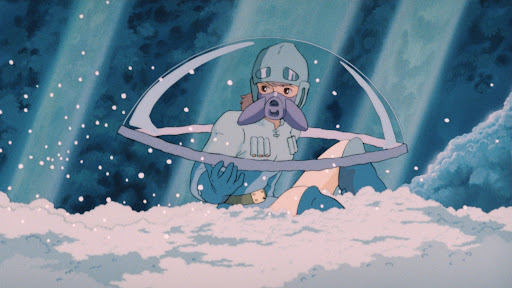
In Nausicaa, the titular character faces fear. She’s the princess of a post-apocalyptic village on the outskirts of a nuclear wasteland, called the Toxic Jungle, which is characterized by toxic spores in the air and massive territorial insects. Just outside the bounds of her village is a land where many things can easily hurt her. Her response to this reality is shown in the film’s first scene, where she explores the Jungle. There, the spores fall like snow as she rests on the carcasses of dead insects. The animators make a vibrantly colorful and textured setting, and musicians create a lively score. This is how Nausicaa experiences the world. She daydreams of a reality where this beautiful land is a place she could stay in more sustainably, but she’s awakened to action when she sees insects attacking another explorer. While the wasteland is beautiful, it is a place where humans have very little control.
Spores falling over Nausicaa in her exploration
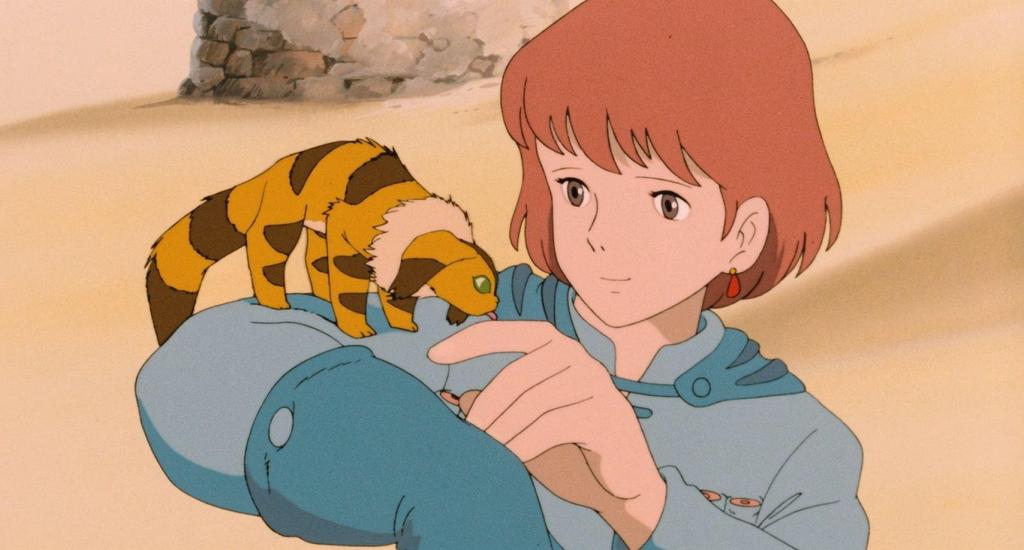
Despite her limited control, Nausicaa always acts for the defense of other humans. When the other wasteland explorer is attacked by insects, she hops on her glider to come to his aid. Nausicaa carries a gun on her, but she instead uses flares and sounds to redirect the insect. She flies close to the insect and uses a noise-making tool to allow her to talk to the insect and command it to return to the jungle. Upon her return to the valley, she finds a mentor returned with stories and a creature who, although a baby, is already vicious and will continue to be as it grows. Yet Nausicaa reaches her hand out for the creature to crawl on her. Though it bites her, she only thinks of it as scared, and by the time it releases its bite, it feels safe to lick her finger affectionately and is her companion for the rest of the story. Her mentor names this as a strange power she has. In these events, we see Nausicaa not only act for the defense of humans but for the good of all the creatures she interacts with, even when she has good reason to fear them.
Nausicaa’s newly calmed companion
Providing the counterexample to Nausicaa are the people of the Torumekian Empire, invaders of the hero’s home in the Valley of the Wind. The Torumekians arrive seeking the dormant body of a Giant Warrior- a superweapon from a thousand years before whose attacks created the Toxic Jungle (a metaphor for the effects of nuclear weapons, but that’s outside the scope of this essay). The Torumekians wish to revive the Giant Warrior and use its power to burn away the Toxic Jungle and return humanity’s control over the Earth. Under all of their actions lie fear and ambition. They fear their vulnerability in a world where they’re prey to insects and victims of toxins. They fear death at the hands of these things they do not control. Their ambition is tied to this fear, as their ambition is to regain the control humans had before the apocalypse. Ambitious control, however, proves to be the incorrect response to fear in the world of Nausicaa.
Nausicaa intuits that there is a greater response to fear, as we see a childhood flashback where she hides a baby Ohm, the apex predators of the insects, as people from the Valley of the Wind search to kill it in order to defend their land. Not only does she intuit this, but she also learns that the Jungle is not something to be lashed out at in fear when she escapes captors who were leading her to the Torumekian capital. She crashlands into the Jungle and sinks to depths below the Jungle floor. There she finds no toxic spores, but instead remains of petrified trees that are safe and create the pure waters used for wells. These are the oldest parts of the Jungle, which have exuded their toxins borne of the Giant Warrior and are now good to sustain life. The Jungle is, in its own way, experiencing fear. The Jungle is toxic only because it was attacked. It must defend itself to live, but once it has let out its toxins, it can sustain life once more. Instead of continuing the cycle by fighting back against the hurt Jungle and making it more toxic, Nausicaa learns that the humans must live with the Jungle and let it heal, finding ways to survive alongside their deadly creation.
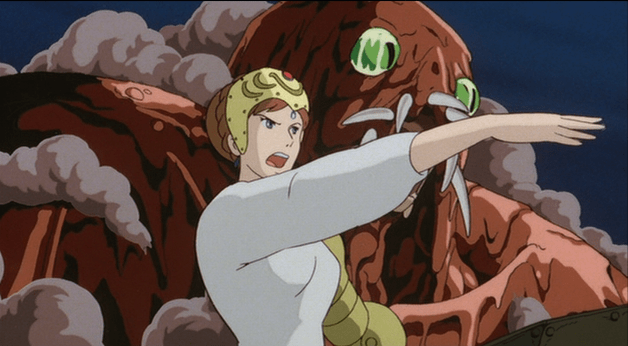
The competing ideologies of Nausicaa and the Torumekians come to a head in the film’s climax when an uncountable horde of Ohms stampede towards the Valley of the Wind, enticed by a 3rd nation who baits them with a wounded Ohm baby. At the time of the attack, Nausicaa is still deep in the Jungle and racing to return home. This leaves the Torumekians in charge of the Valley of Wind. While the Giant Warrior is not fully ready, the Torumekian princess decides that awakening it is their only defence. Upon its appearance, the awakened Warrior is evidently incomplete. Its appearance is like melting wax, and its movements are slow and labored, but the Torumekian princess orders it to fire its laser beam on the Ohms anyway. Creating a mushroom cloud explosion, the beam kills many Ohms, but the princess is not satisfied, ordering the Warrior to fire again— and faster this time. Though the Warrior gets one more beam off, the effort melts the rest of its body, rendering it unable to continue its attack. While the princess raised this Warrior to be humanity’s salvation from the Toxic Jungle and its insects, she used it hastily as a control-seeking response to fear. In doing so, she ruins her efforts.
The Torumekian princess and the Great Warrior
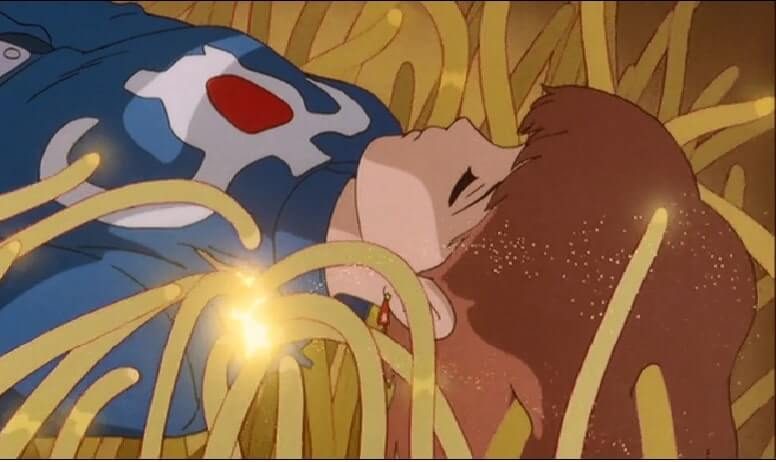
Nausicaa’s response to the Ohm stampede in the climax is the story’s heroic response to fear. She identifies the baby Ohm as bait and is filled with compassion for it. She recognizes that not only is the baby suffering as a captive, but that the stampede of Ohms are suffering in their blind rage. She is not void of fear; she knows that the Ohms are bound to destroy her beloved home and people she has worked to protect if the stampede continues, but her experience in the Jungle has taught her that the world is seeking restoration, not simply to attack humans. Restoration, she knows, cannot happen if humans continue angering the Ohms, so she must find a way to protect the humans without harming the Ohms. Ultimately, she flies in front of the Ohms to free the baby and dies in the stampede. The Ohms, recognizing her sacrifice, cradle her and bring her back to life, then return to the Jungle to care for the baby.
Nausicaa cradled by the Ohms
In Nausicaa, the world is hurt. It has been harmed by humans who use power in search of control because they are unwilling to confront their own fear in any other way. In return, it acts in ways that harm humans. The hero, though, is the human who confronts her fear with the perspective of acknowledging others’ fears. She knows she can be harmed, but she also knows that she is capable of harming the world around her. In response, she chooses compassion. She shields the weak and vulnerable of both her own people and of the Ohms, and in turn, she is able to create greater peace for both.
I love this story, and many like it, because I love its world. It is a place where goodness does not necessarily beget goodness, but where goodness, particularly the forms of courage and compassion, is rewarded as a virtue. This does not mean Nausicaa’s life is easy because she’s good. In fact, the dystopian world she lives in has all the harshness of our own. She loses loved ones. She’s betrayed. She can’t protect all the people she wants to. She dies. The Jungle is not destroyed. Yet the narrative shows that her goodness was the only way forward. If not for Nausicaa’s sacrifice, her village would die. If she held herself with any less courage or addressed her fears any other way, then the story would not end with peace. Nausicaa does not get a rosy ending. People still died. The Jungle still expands. She does, however, get an ending with hope. She knows the way to restoration. She will not see the world restored in her lifetime, but if others follow her example, the Jungle will recede and the world will cease to hurt as it does now.
Nausicaa’s challenge to me was to believe in a world kinder than I expect it to be. I picked up those teen dystopias in 6th grade not because they were well written (I’m quite sure many of them weren’t), but because they showed me the world I believed in. Someone really was out to get Katniss. Some days, I still do feel like there’s someone out to get me, but that’s not the world I believe in. I believe in a world where goodness may not always lead to positive outcomes, yet that humans acting in goodness is the only way forward. I believe that there is something fundamental in the fabric of our world that seeks restoration, and that goodness is worthwhile because of it. I believe in a Creator who is continually working the Jungle into a healed world. And I believe so many others deeply want to believe in that reality; that’s why we tell these kinds of stories to our children. We want them to believe the world is that way. We want them to know that Good is coming. When we are no longer children, however, these stories speak no less truth. In fact, I find I need them all the more when I do not have the vision to see my own world as good. Perhaps it is only escapism, or perhaps these stories remind me to believe that my world’s story is one worth believing in, too.
Thank you for reading my first essay on this blog! Nausicaa’s story was a comforting encouragement to me as I watched. As I was writing this, I was reminded of the song “The Helpers” by Paper Horses- a song about a real world source of continued encouragement, I highly recommend it 🙂
Hi! I’m Hayden, and this is my blog. If you’re reading this first post, I imagine I did not need to tell you that. You are probably not an internet voyager. You’re probably a friend who has a vested interest in me. Thanks! If you’re one of those, there’s a very small chance you are an internet voyager. The Venn diagram between my friends and people who spend a great amount of time on the internet is fairly small. Hi Laura Beth.
So what is this for? Primarily, I want to keep learning. When, in English, we talk about a lack of growth, we use words like stagnant, static, and still. Watery words. When water is stagnant, static, or still, it is no longer good for drinking. It does not sustain life the way it once did. Movement keeps the water pure. My prayer is that, through writing my thoughts, I may become more pure. I desire to be good for life, like running water. Let me be clear, I do not think this blog is my way of making the world a better place. I am convinced that only actions can make the world better. Nevertheless, I am an extreme external processor, and I need externalized language to iron out my thoughts. The aim is that those thoughts, once known, will help me decide how to do good things. In a real way, the audience of this blog is myself so that I may reflect and grow. Perhaps you will read it, too. I suppose you are. I hope my attempts to make sense of the world around me will be a worthwhile read for you.
I am convinced one of the best ways to begin making sense of things in my young life is to read. I’m a recent graduate of Berry College (c/o 2025), and, in the past four years, I’ve gathered a strange love for the academic process of taking in new information through text and synthesizing my thoughts on what I’ve read in my own writing. Anyways, many people have lived a lot more life than I have, and I’d be foolish not to try and learn from them. My intent is for this to be a place for me to process and, in some way, dialogue with great writers. For any of my dear professors who have read my papers and may read this, beware. Here, I will have even less formality and an even more conversational tone than in my supposed academic writing! I write now as one with no academic pretense, motivated only by great curiosity and zeal for learning. I swear I’ll still revise and edit these posts, though. I do want to make some sense.
The name of this blog is The Big Idea because that is what I care about. I love engaging with big ideas, and I want to make a lifetime habit of doing so. Here, I will respond to ideas I care about. Many of those ideas will stem from explicitly Christian writings, as they hold central priority in my life. Others will be compelling fictional stories. Perhaps I will post some thoughts on musical pieces. Maybe write some poetry. If I’m feeling wild, I may even write about some truly cutting-edge basketball schemes. I don’t entirely know what I’m getting myself into. If nothing else, I’ll have a solid collection of thoughts from my idealistic twenty-something self. That I can guarantee. After all, the reason I finally started writing this was because I was grabbed by a lyric from Oh Jeremiah’s “Joymonger (Reprise)”: “Joy can come from nothing, after all.” So I will write this blog as a young person full of joy and a desire to dig into this life. I may not make sense of much of it, but life’s too important not to try.
Looking forward, I have some poem ideas that I’ve been compelled to write as well as having just finished Esau McCauley’s Reading While Black and Lewis’ Chronicles of Narnia, so I have some big ideas looking to be ironed out soon 🙂
 The Big Idea